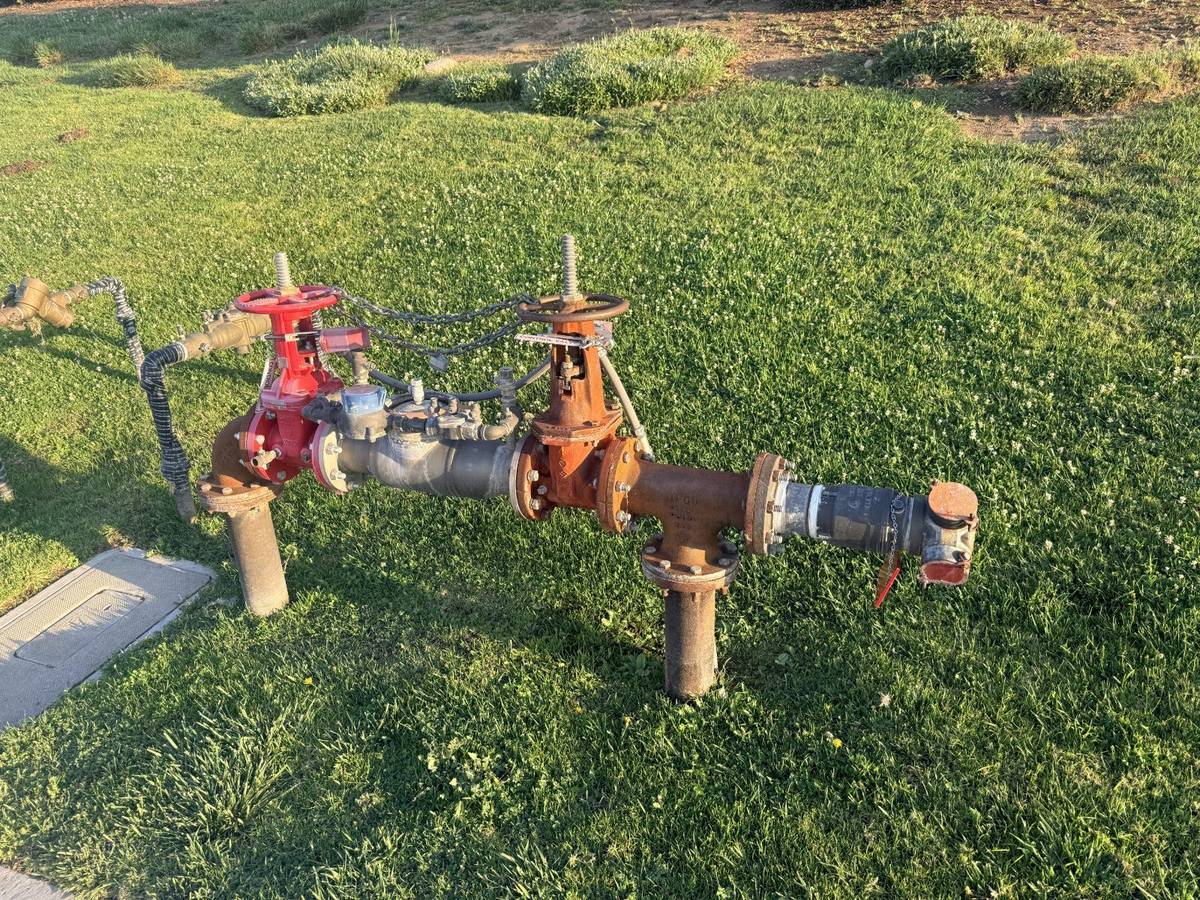
Every backflow assembly on your property is a mechanical device sitting outdoors, under constant pressure, handling whatever the water main sends through it. It has moving parts, rubber, and springs. Given enough years, it will fail. That isn't a defect — it's the whole reason annual testing exists.
So the useful question isn't whether yours will fail. It's how they fail, what you can actually see from outside, and how much warning you get. This page covers all three.
One thing to get out of the way first, because it comes up constantly and it's wrong: there are no sensors inside a backflow assembly. No electronics, no alarm, no monitoring device, nothing to plug into. The whole thing is hydraulic and mechanical — springs, rubber discs, and water pressure doing the work. That's why an annual test by a certified tester is the only way to know its condition. There is no dashboard version of this.
What "Failure" Actually Means
An assembly doesn't usually fail by falling apart. It fails by no longer holding the pressure differential it's required to hold. When we test, we're measuring specific numbers:
- Double check (DC) — each check must hold at least 1.0 psid.
- Reduced pressure (RP) — check 2 holds at least 1.0 psid; check 1 holds at least 5.0 psid and at least 3.0 psid above the point where the relief valve opens; the relief valve must open at 2.0 psid or more.
- Pressure vacuum breaker (PVB) — the check holds at least 1.0 psid and the air inlet opens at 1.0 psid or more.
Miss any one of those and the assembly fails, even if it looks perfectly fine and the water tastes normal. That's the point — it's protecting against a condition that hasn't happened yet. If you want to see what those readings look like on paper, we walk through it in what a passing test report looks like.
What Actually Breaks
Roughly in the order we run into them:
Debris on the check seats. This is number one and it isn't close. A check valve seals rubber against a machined seat. A grain of sand, a flake of pipe scale, a scrap of Teflon tape, or a bit of construction debris lodged on that seat holds the disc open a few thousandths of an inch, and the check won't hold its differential. Cities flushing mains, hydrant use, and upstream repairs all push debris downstream. It's also the reason a device can pass one year and fail the next with nothing else changed.
Hardened or worn rubber. Check discs, o-rings, and the relief valve diaphragm are elastomer. Southern California water is chloraminated, and years of chloramine exposure hardens rubber so it stops conforming to the seat. Sun and heat on an above-grade assembly speed it up. This is the classic age-related failure, and it's why a fifteen-year-old device starts failing repeatedly even after a good rebuild.
Spring fatigue and corrosion. Every check is held closed by a spring. Springs weaken, and in a damp vault or on a coastal property they corrode. On an RP this usually shows up as check 1 dropping below the 5.0 psid it has to hold — the device still functions, but it no longer has the margin the standard requires.
A fouled relief valve. On an RP, the relief valve is the single most commonly replaced part. Get debris or a worn seat in there and it either leaks constantly or won't open at the right point. If yours is discharging, we cover that specific symptom in detail in why the relief valve on my RP is discharging water.
Worth being precise about the relief valve, because almost everything written about it online is wrong. It's a differential valve. It watches supply pressure against the zone between the two checks, and when that zone comes within about 2 psi of supply, it opens to atmosphere and dumps. It is not an over-pressure device, it has nothing to do with high pressure in your building, and it never shuts off water service. Here's how it actually works.
Scale and mineral buildup. Hard water leaves deposits on seats, guides, and stems. Inland properties see this far worse than coastal ones — it's a routine finding out toward Riverside and San Bernardino. Scale on a guide stem makes a check sluggish, and a sluggish check fails the test.
Freeze damage. Cracked bodies, split bonnets, blown relief seats. Not a Long Beach problem. Very much a Palmdale, Lancaster, and high-desert problem, and it shows up every spring after a cold snap. An uninsulated assembly out there is on borrowed time.
Improper installation. Wrong orientation, not enough clearance, installed backwards, undersized for the flow, no air gap or drain under an RP's relief port, buried below grade, or unsupported so the piping is straining the body. Some of these cause an outright failure. Others just guarantee it fails inspection every single year until somebody corrects it. Most of it traces back to where the assembly was placed to begin with.
Thermal expansion and pressure spikes. A closed system with a water heater and no expansion tank pushes pressure back against the downstream check every time the heater fires. Add water hammer from a pump or a fast-closing irrigation solenoid and the internals take a beating. Where we see this, the fix isn't in the assembly at all — it's an expansion tank or a pressure regulator upstream. Repeated failures on the same device usually mean this.
Age. Most assemblies give you somewhere between fifteen and twenty years before rebuilds stop holding. Past that, the body itself is often the problem — worn seats that can't be machined back, or a discontinued model with no parts available. We go deeper on that in the lifespan of backflow preventers.
Warning Signs You Can See From Outside
You don't need to be a certified tester to catch most of these:
- Water discharging from the relief port on an RP. A brief discharge during a pressure fluctuation isn't automatically a failure. A steady drip, or a discharge that keeps recurring, means the zone between the checks is losing pressure. Don't ignore it, and don't ever cap the port.
- Water weeping from a test cock or a bonnet. Test cocks are the small valves on the body we use for testing. A weeping test cock is usually cheap to fix — and a sign nobody's looked at the assembly in a while. More on leaks and drips here.
- Staining, algae, or standing water underneath. Even after a leak stops, the mineral staining and green growth stay. It's the most reliable evidence of an intermittent discharge nobody was around to witness.
- Banging or hammering when irrigation or a pump cycles. That's a pressure problem, and it's shortening the life of the internals.
- A vacuum breaker spitting when the irrigation comes on. On a PVB, that's the air inlet not sealing.
- A noticeable drop in downstream pressure. Usually a fouled or seized check. We cover the pressure question separately, because the answer surprises people.
- Visible damage. Corrosion, a device knocked out of alignment by a vehicle, missing bolts, a cut lock, or a cage that's been pried at. Theft and vandalism are real problems on commercial sites around here, and a partially stripped assembly can look intact from twenty feet away.
The sign almost everyone misses: your own test reports. Look at the actual numbers year over year, not just pass or fail. A check that read 8.0 psid three years ago, 6.5 last year, and 5.4 this year is on its way out — even though every one of those is a pass. That's the difference between scheduling a rebuild on your timeline and getting a failure notice on the water district's.
What Happens When It Does Fail
The water district finds out. Your test report goes to the purveyor, and a failed report starts a clock. How long you get to repair and retest varies by district — some allow thirty days, some allow considerably less on a high-hazard connection. Ignore it long enough and the district can and will shut water service off to the property. That's the part that turns a small repair into a real problem. We walk through the whole sequence in what happens if your device fails its annual test.
In the meantime you're out of compliance. For a property manager running a portfolio, a red-tagged connection at one site means paperwork, phone calls, and a tenant who wants an answer today.
And the underlying risk is real. A failed assembly on a high-hazard connection — irrigation with fertilizer injection, a boiler running treatment chemicals, a fire line full of stagnant water — is the only thing between that water and the drinking supply. It doesn't fail dramatically. It just quietly stops protecting.
How To Keep Them Alive
Test annually and actually read the report. The annual test is the maintenance program. There isn't a separate one, and anyone selling you one is selling you the test.
Watch the compliance date, not the anniversary of your last test. This trips up more property managers than anything else on this page. Plenty of purveyors don't use a rolling twelve months from your service date — they assign a fixed compliance month, and the test is due in that month no matter when you last had it done. If you own property across several districts, you're tracking several different rules at once. It's the single most common reason an otherwise well-run property ends up out of compliance, and it's the main reason it's worth using one company that tracks it across jurisdictions instead of a different tester in every city.
Keep it accessible. Locks removed or keyed to your vendor, alarm on test mode, landscaping cut back, nothing stacked in front of it. An assembly nobody can reach is one that doesn't get tested.
Insulate where it freezes. If the property is in Palmdale, Lancaster, or anywhere inland that drops below freezing, insulate before winter rather than replacing a cracked body after.
Fix the pressure problem, not just the device. Adding an expansion tank costs a lot less than rebuilding the same assembly every year.
Retest after upstream work. A water main break or a district repair upstream sends debris straight into your checks. If there's been work on the main near you, expect it.
What We Do About It
When we test an assembly and it fails, you get the actual readings, a photograph of the device, and a straight answer on whether it's a rebuild or a replacement — and if it's a replacement, why. We photograph every backflow we test whether there's a problem or not, and the paperwork goes to the water district either way.
We won't pass a device that failed. Not for a repeat customer, not for a big account, not for any price. It puts our license at risk and it puts everyone's water at risk, and there's no version of this business where that trade is worth making.
What it costs
Testing — $90 per device in most of Los Angeles and Orange County. $450 minimum in Palmdale, Lancaster, Ventura, Riverside, San Bernardino, and San Diego counties, which covers up to five devices, then $90 per device after that.
Repairs — from $200, depending on device size and what's actually wrong with it.
Replacements and installations — priced by size and difficulty. You'll get a written estimate before any work starts. Please let me know if you have any questions or concerns — call (562) 343-1436.